In mixing and dosing systems, dosing and mixing technology often determines cycle times, process reliability, and consistent product quality. The challenge becomes even greater when handling sensitive raw materials and tight production schedules, where precise weighing is essential. At the same time, manufacturers seek to reduce manual intervention and increase automation.
This case study demonstrates the transition from a conventional tipping bucket solution at a kneader to a synchronized, fully automated belt weighing system—implemented as a scalable building block for reliable batch management.
Initial Situation
The customer had previously dosed materials using a conventional tipping bucket system connected to the kneader.
While this approach was functional in daily operation, it presented several limitations and operational challenges.
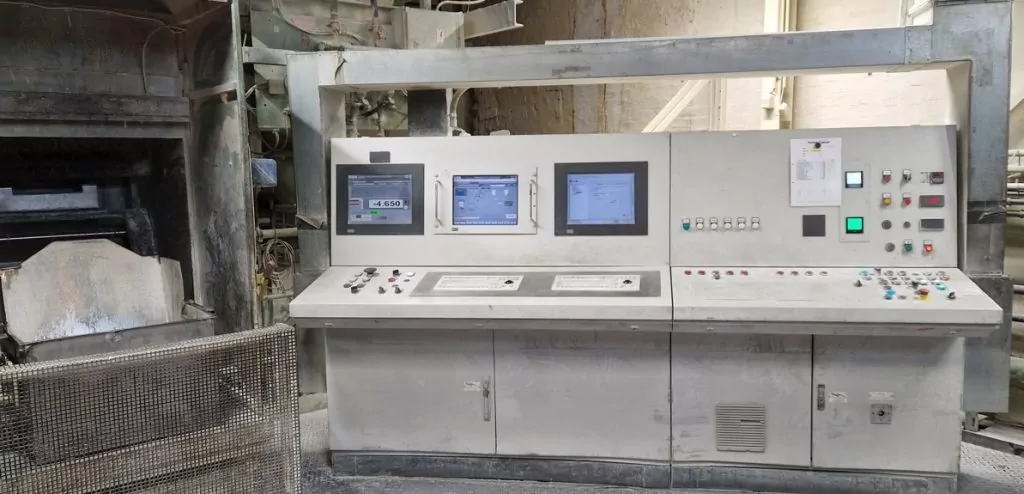

The Consequences:
- Manual dosing operations
- No capability to pre-weigh multiple batches
- Continuous operator presence required
- Limited flexibility in production scheduling
- Potential material losses during the tipping process
Particularly when handling sensitive raw materials and operating under tight production schedules, this approach resulted in unnecessary labor requirements and limited overall process reliability.
Project Objective
The customer was looking for a solution that would:
- Provide controlled and highly accurate pre-weighing of raw materials
- Allow multiple batches to be prepared in parallel
- Ensure fully synchronized and position-accurate transfer to the cyclic conveyor system
- Transport raw materials gently and without tipping
- Enable flexible material calls for the mixer
- Significantly reduce manual labor requirements
Additionally required:
An integrated extraction mechanism for rubber strips, including automatic weight control and a defined stop at the target weight.
The Solution: Customized Cyclic Belt Weighing System
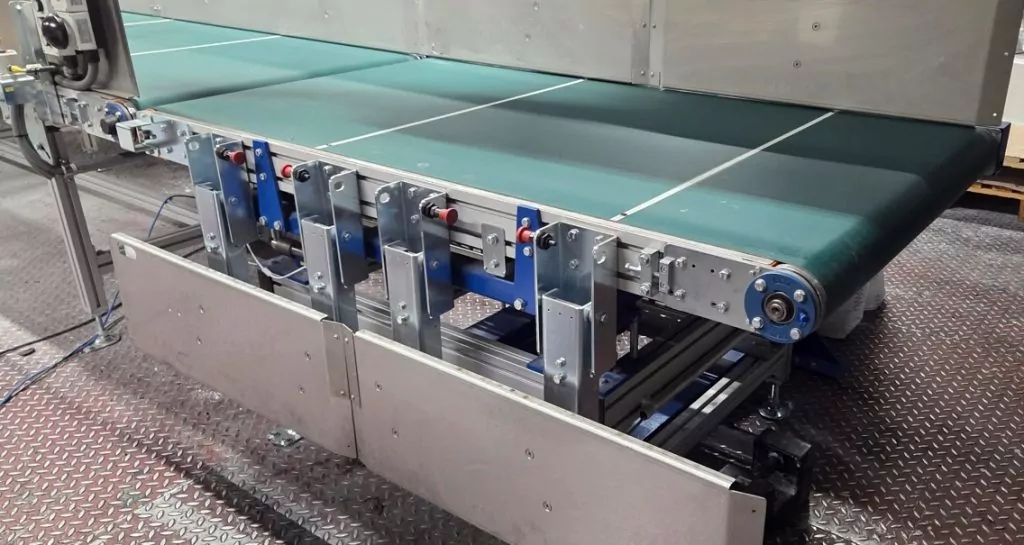
To meet the requirements of mixing and dosing technology, a customized cyclic belt weighing system was integrated. As a dosing belt scale within the mixing and dosing system, the solution combines structured pre-weighing, synchronized conveyor technology, and section-based belt control for automated material dosing in cyclic operation.

1. Systematic Pre-Weighing
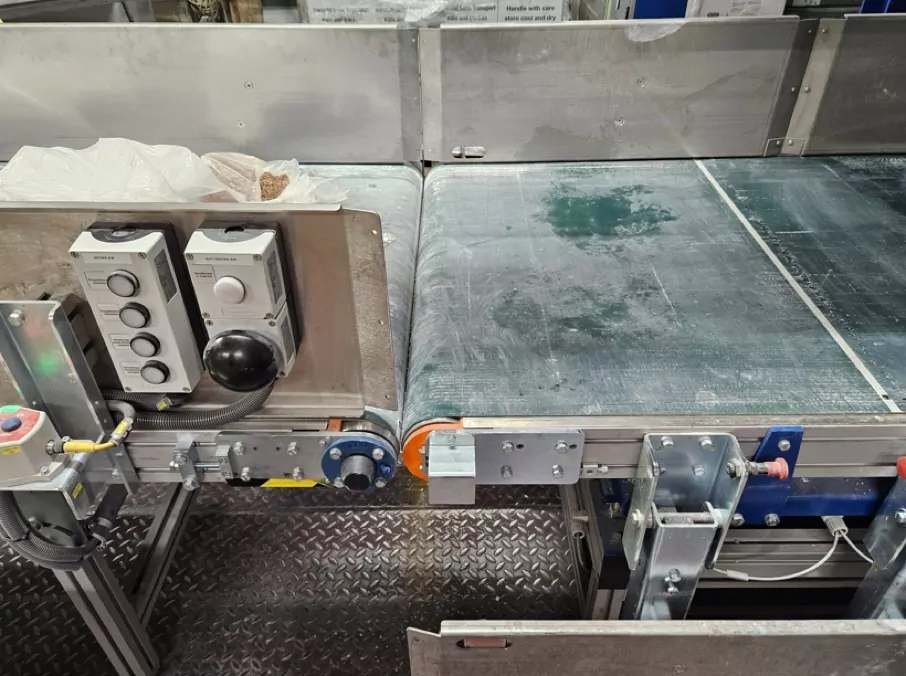
Pre-weighing is carried out within a clearly defined system: The weighing process takes place exclusively on the first conveyor section. The operator logic enables both individual weighing and cumulative weighing via confirmation.
- Weighing exclusively on the first conveyor section
- Individual or cumulative weighing via confirmation
- Pre-weighing of up to 7 kneader batches possible
- 6 batches on the cyclic conveyor
- 1 batch on the weighing section
Example: Precise confirmation of a target weight (e.g., 11.89 kg) before transfer.
Result: Significantly higher process reliability and reproducible batch quality through the belt weighing system during the pre-weighing process.
2. Synchronized Conveyor Technology
A key element of the solution is the synchronized conveyor technology. Separately driven conveyor belts are used to ensure stable and position-accurate transfers—even under full load.
- Separately driven conveyor belts
- Guaranteed:
- Synchronization
- Position accuracy
- Guiding accuracy – even under full load
- Gentle, tipping-free transfer
This is particularly relevant when handling opened melt material bags or sensitive materials.
→No material loss. No uncontrolled shifting. Maximum stability.
3. Intelligent Section Logic
To provide greater flexibility during ongoing operation, the system is divided into visually separated conveyor sections. This logic transforms the conveyor into more than just a belt weighing system—it becomes a structured buffering and retrieval system, ideally suited for flexible production processes in dosing and mixing technology.
- Visually separated conveyor sections
- Can be pre-loaded for multiple retrieval cycles
- Each section designed for:
- 2 stacked bales
- 800 × 450 × 150 mm (up to 300 mm stacking height)
A reverse operation of the infeed conveyor enables optimized loading. Available loading positions can be used flexibly, even without continuous operator presence.
→Significantly increased system flexibility during ongoing operation.
4. Integrated Post-Processing of Rubber Strips
In addition to weighing and transfer, a post-processing mode for rubber strips was integrated. In this mode, two sections are transported synchronously and fully automatically. The weight control is implemented in such a way that the system automatically slows down before reaching the target weight and stops precisely once the target weight is achieved.
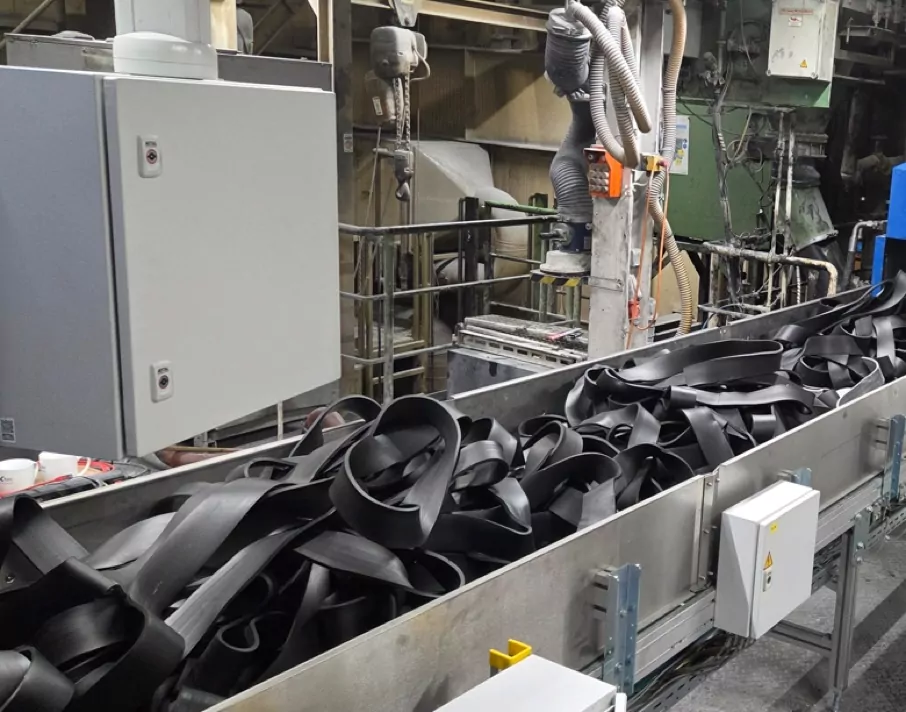
- Strips occupy two segments
- Thickness: 3–12 mm
- Width: 40–150 mm
- Speed: up to 40 m/min
- Automatic deceleration before reaching the target weight
- Automatic stop at the target weight
- Manual cutting
→Precision down to the smallest detail – without additional operator effort.
Customer Result
The customer successfully transitioned from the manual tipping bucket solution to a fully automated cyclic belt weighing system.
Through structured pre-weighing and synchronized transfer, a stable and reproducible process has been achieved, providing significant advantages—particularly when integrated with mixing and dosing systems.
Specific Benefits of a Fully Automated Belt Weighing System:
- Time savings through structured pre-weighing
- Parallel batch management
- Significant reduction in manual intervention
- Reduced operator requirements
- Gentle material handling
- Reproducible processes
- Higher process reliability and planning security
Conclusion
The fully automated cyclic belt weighing system is more than just a new dosing solution.
It is a key component for a scalable, reproducible, and future-proof production structure.
Through structured pre-weighing and synchronized transfer, batches are reliably prepared and delivered to the process exactly when required. At the same time, manual effort during operation is reduced, while process reliability and planning capability in mixing and dosing systems are significantly improved.
Fully automated cyclic belt weighing system – a clear step toward:
Efficiency. Process stability. Industry 4.0.


